Vastu Purusha Position in a House: Who Is He and Where to Place Him?
Introduction
Have you ever wondered why Vastu Shastra gives so much importance to the centre, directions and layout of a house? Why is the northeast direction considered important, and what is the significance of the Vastu Purusha Mandala in traditional Indian architecture?
The answer to many of these questions is connected with an important concept of Vastu Shastra known as Vastu Purusha.
In traditional Indian architectural philosophy, this concept represents the cosmic energy and symbolic presence of a building or a piece of land. It connects the human body, the five natural elements, directions and the planning of living spaces.
Whether you are constructing a new house, purchasing a property, renovating your home or simply learning about Vastu Shastra, knowing this concept can help you understand the traditional principles behind spatial planning.
In this complete guide, we will explore who he is, the story behind him, the Mandala, his traditional position in a house, where to place his image or idol, and common questions about his placement.
1. Who Is Vastu Purusha?
Vastu Purusha is a symbolic cosmic being described in traditional Vastu Shastra texts. He represents the spirit or presiding principle of a building, land or constructed space.
The word Vastu refers to a dwelling, building or place, while Purusha represents a cosmic being or universal person. Together, the name stands for the relationship between a physical space and the cosmic order according to traditional Indian architectural philosophy.
In Vastu Shastra, the entire building is linked with his body. Each part of his body matches a direction and zone of the building.
The traditional picture shows him lying face down on the ground, with:
- His head towards the Northeast (Ishan Kona).
- His feet towards the Southwest (Nairitya Kona).
- His upper body occupying the central region.
- His arms and other body parts extending towards the Northwest and Southeast.
This symbolic arrangement forms the foundation of the Mandala.
It is important to understand that this is a traditional religious and architectural concept, not a scientifically established physical energy field.
2. The Story and Significance of Vastu Purusha
According to traditional Vastu mythology, a powerful and enormous cosmic being appeared during the process of creation.
His enormous form began occupying space and disturbing the natural order. The gods approached Lord Brahma for a solution.
Lord Brahma and the other deities collectively restrained the being and placed him face down on the earth.
Different deities occupied different parts of his body, while Lord Brahma was linked with the central part.
After this event, Lord Brahma named him Vastu Purusha and granted him an important place in the planning and construction of buildings.
According to the traditional account, he would be remembered and worshipped whenever a new building or structure was constructed.
Why is this story important?
The story is not simply a mythological description. It explains the symbolic relationship between directions, deities and architectural spaces. It provides the philosophical foundation for:
- The Mandala.
- Directional divisions of a building.
- The importance of the Brahmasthan.
- Traditional Vastu rituals before construction.
- The relationship between the building and the natural elements.
Thus, the story reflects the traditional idea that a building should be planned in harmony with its surroundings and spatial layout.
3. What Is Vastu Purusha Mandala?
The Vastu Purusha Mandala is one of the important planning concepts in traditional Indian architecture.
It is a geometric diagram, usually based on a square grid. Each section is given to a deity and a direction. The Mandala stands for his body. It is used in traditional building planning to understand how different areas of a building relate to one another.
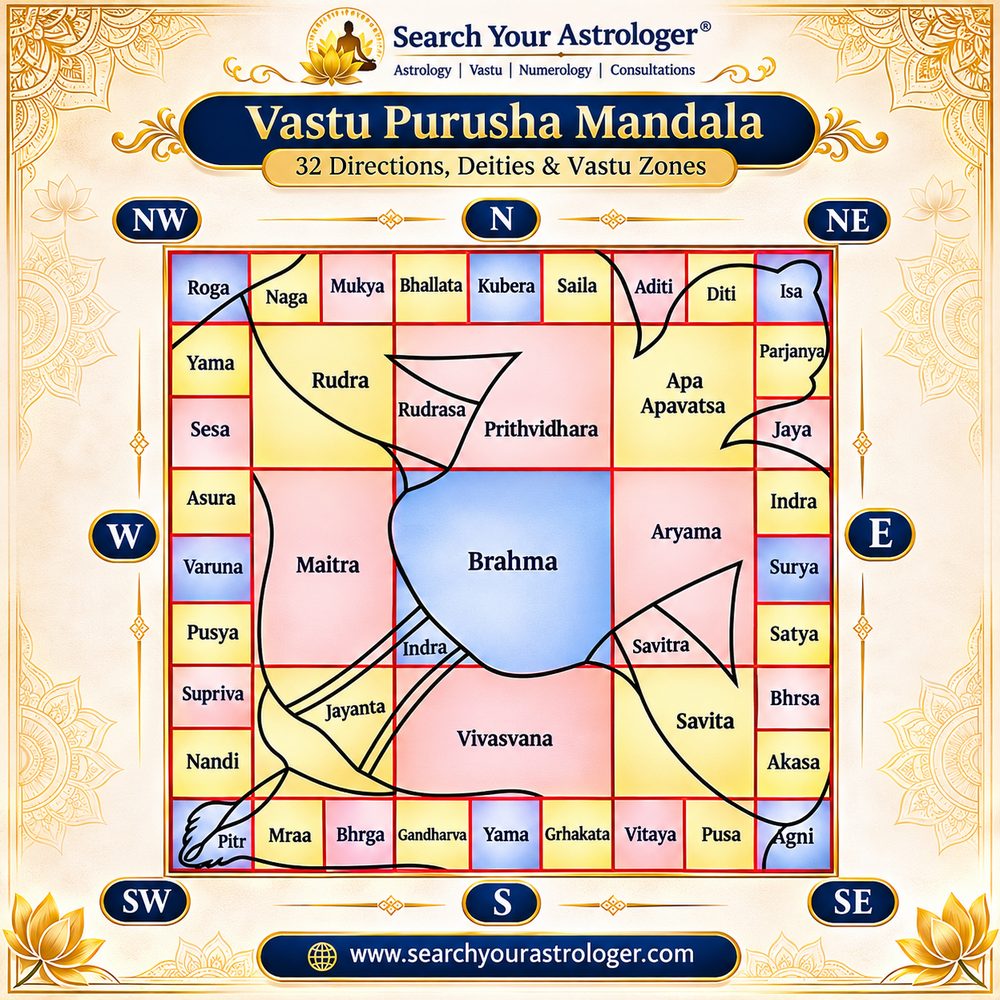
Main Types of the Mandala
Two well-known traditional Mandala arrangements are:
1. 64-Pada Mandala (Manduka Mandala)
This arrangement consists of 8 rows and 8 columns, creating 64 smaller squares. It is especially linked to traditional temple architecture.
2. 81-Pada Mandala (Paramasayika Mandala)
This arrangement consists of 9 rows and 9 columns, creating 81 smaller squares. It is linked to residential and other building planning, although the applications of these grids vary across different architectural texts.
Importance of the Mandala
The Mandala helps explain:
- The central zone of a building.
- The relationship between different directions.
- The distribution of traditional deities.
- The arrangement of architectural spaces.
- The relationship between the building and its symbolic cosmic order.
The Mandala is therefore much more than a decorative diagram. It is a traditional building planning framework.
4. Position of Vastu Purusha in a House
One of the most frequently asked questions is: where is he located in a house?
According to the traditional Mandala, his position is represented across the entire plot or building rather than in only one room. His body is spread across different directional zones.
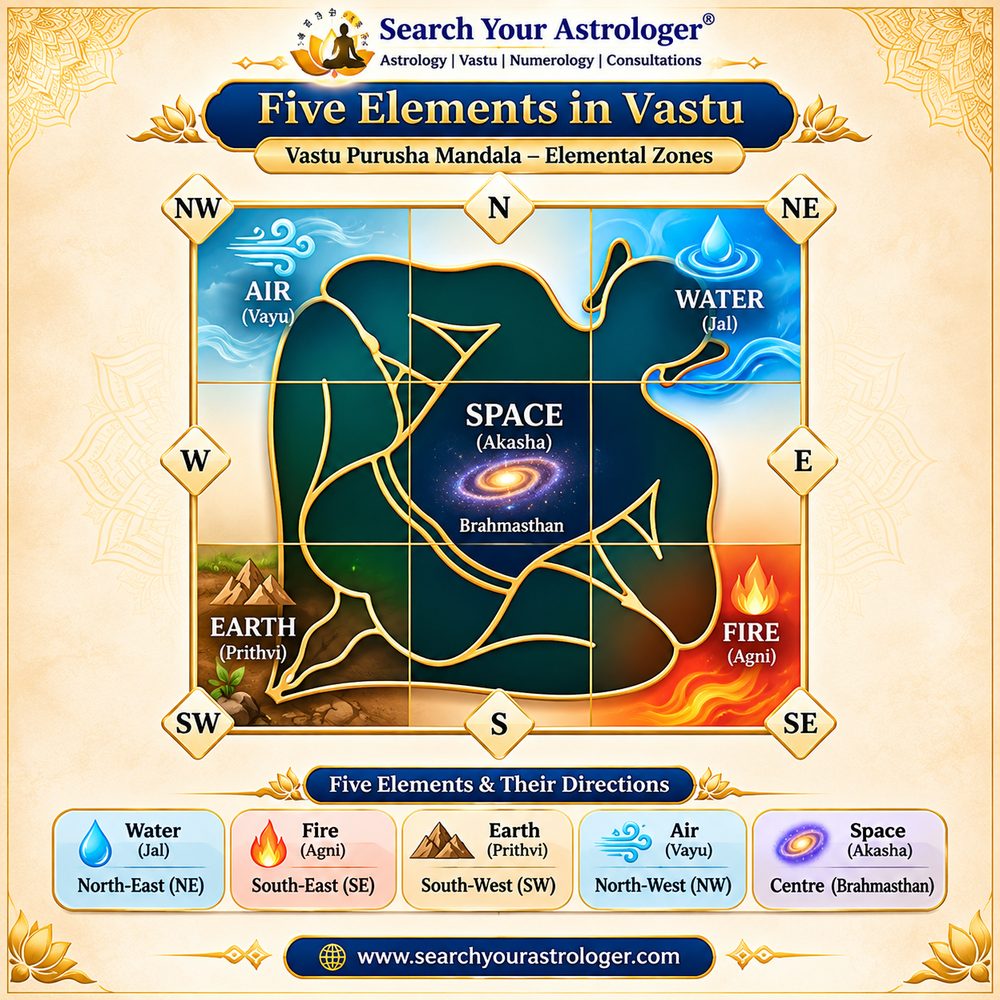
Traditional Position in the Mandala
| Body Part | Direction |
|---|---|
| Head | Northeast |
| Feet | Southwest |
| Right arm | Southeast |
| Left arm | Northwest |
| Central body | Brahmasthan |
This arrangement is important for understanding the traditional directional divisions of a house.
Why is the Northeast important?
The Northeast is known as Ishan Kona. It is linked to clarity, water, worship and spiritual activities in many Vastu traditions. In the symbolic picture, his head occupies this direction.
Why is the Southwest important?
The Southwest is known as Nairitya Kona. It is linked to stability, strength and the earth element. In the Mandala, his feet are positioned towards this direction.
What is Brahmasthan?
The central area of the Mandala is known as Brahmasthan. Brahma is linked with the central part of the Mandala. In residential Vastu planning, this area is generally recommended to remain relatively open, clean and free from needless blocking.
5. Where to Place Vastu Purusha in House?
This is one of the most important questions people search for online.
The first thing to understand is that there is a difference between the symbolic position of Vastu Purusha in a house and the physical placement of his picture, idol or Yantra.
Vastu Purusha is not traditionally shown as a physical object that must be installed in every house.
His symbolic presence is linked to the complete building through the Mandala. However, people who follow Vastu traditions may choose to keep his image, Yantra or form in a suitable place.
Suggested traditional placement
If you wish to keep his picture or form at home:
- Choose a clean and peaceful location.
- A dedicated Puja room or worship area can be considered.
- Keep the image or form on a clean and stable surface.
- Follow the placement instructions linked to the specific Yantra or image.
- Consult a knowledgeable Vastu practitioner for a traditional installation ritual if required.
There is no single accepted placement rule for every image, idol and Yantra. The correct placement can depend on the particular form, its purpose and the tradition being followed.
6. Where to Keep Vastu Purush at Home?
If you are wondering where to keep Vastu Purush at home, consider the following traditional options.
1. Puja Room
A clean and peaceful Puja room is a commonly considered location for religious images and Yantras. If you keep his image here, maintain a clean and respectful arrangement.
2. Dedicated Spiritual Area
If your home has a separate meditation or spiritual area, it can also be considered. The space should be peaceful and should not be used as a storage area.
3. During House Construction
By tradition, he is closely linked to the construction process. Vastu Puja or Vastu Shanti rituals are performed in certain traditions before construction or during housewarming ceremonies. These rituals are intended to seek blessings for the building and its occupants.
Important: Keeping a Vastu Purusha idol at home is not compulsory according to a single universal rule. Traditional Vastu concepts can be followed through building planning and rituals without installing a physical idol.
7. Vastu Purusha Pratima Direction
Another popular question is: which direction should he face? There are two different things to understand.
First: the traditional direction of the figure in the Mandala. In the commonly illustrated traditional arrangement:
- His head is towards Northeast.
- His feet are towards Southwest.
- His face is turned towards the ground.
Second: the direction of a physical Vastu Purusha Pratima. The orientation of a physical image or idol depends on its particular design and the tradition linked to it. It is not correct to assume that every Pratima must face the same direction.
If you are purchasing a Yantra or idol, follow the manufacturer’s installation instructions or seek guidance from a knowledgeable practitioner. Do not confuse the symbolic orientation in the Mandala with the facing direction of a physical image.
8. Vastu Purusha and the Five Elements
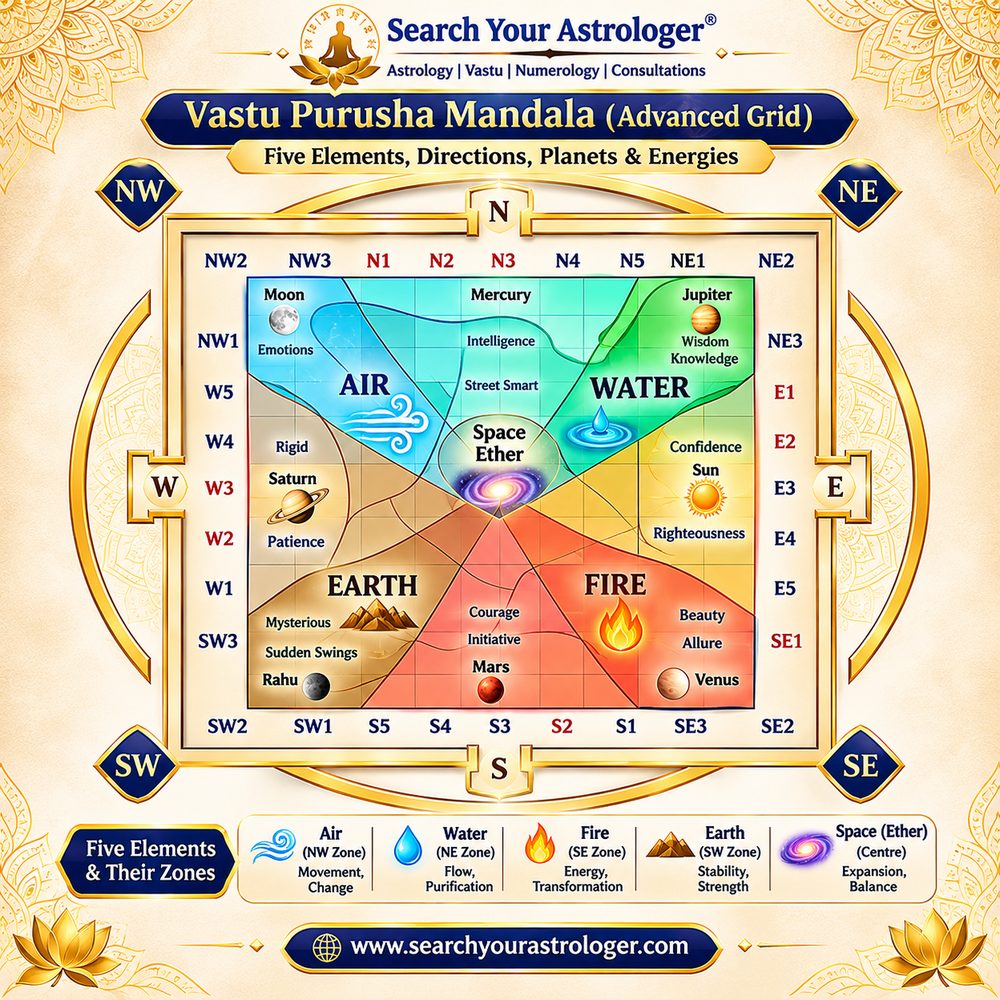
The traditional Vastu system also connects architectural spaces with the five fundamental elements, known as Pancha Mahabhutas. These elements are:
- Earth (Prithvi)
- Water (Jal)
- Fire (Agni)
- Air (Vayu)
- Space (Akash)

In commonly followed directional interpretations:
| Element | Direction | Traditional Association |
|---|---|---|
| Water | Northeast | Purity and flow |
| Fire | Southeast | Heat and transformation |
| Earth | Southwest | Stability |
| Air | Northwest | Movement |
| Space | Centre | Openness |
These associations help explain the traditional approach to spatial planning. For example:
- The Northeast is often linked to water-related spaces.
- The Southeast is linked to cooking and fire.
- The Southwest is linked to stability and heavier structures.
- The Northwest is linked to movement and air.
- The central zone is linked to space and openness.
These are traditional Vastu interpretations, and specific recommendations may differ between schools of Vastu.
For a detailed explanation, read our related article: Five Elements of Vastu: Directions, Zones, Colours and Their Significance.
9. Common Mistakes Related to Vastu Purusha Placement
Many homeowners misunderstand this concept and make needless changes to their houses. Here are some common mistakes to avoid.
Mistake 1: Thinking He Must Be Installed in Every Home
It is primarily a symbolic architectural concept. Installing a physical idol is not a universal requirement.
Mistake 2: Confusing His Position with Idol Direction
His head is shown towards the Northeast in the Mandala. This does not automatically determine the facing direction of every physical idol.
Mistake 3: Ignoring the Brahmasthan
The central area of the house has an important place in traditional Vastu planning. Heavy blocking in this area is generally discouraged.
Mistake 4: Following Every Online Placement Rule
Different Vastu traditions and architectural texts may describe different arrangements. Always understand the context before following a recommendation.
Mistake 5: Confusing Vastu with the Five Elements
The Mandala and the five elements are connected concepts, but they are not the same subject. Each deserves a separate understanding.
Mistake 6: Making Structural Changes Without Professional Advice
Do not demolish walls, change structural supports or modify electrical and plumbing systems simply because of an online Vastu recommendation. Building safety and practical requirements should always come first.
10. Why It Matters in Modern Home Planning
Even in modern architecture, this traditional concept can be studied as a system of spatial planning. Its principles encourage people to think about:
- The relationship between different areas of a house.
- The importance of natural light.
- Ventilation and air circulation.
- Open and functional central spaces.
- The arrangement of rooms according to their purpose.
- The relationship between a building and its surroundings.
These practical considerations can contribute to a comfortable living environment when adapted appropriately.
However, the traditional claims about cosmic energy, prosperity or health benefits should be understood as cultural or spiritual beliefs rather than scientifically proven outcomes. A well-designed home should combine practical architecture, structural safety, natural ventilation, lighting and the personal preferences of its occupants.
11. Frequently Asked Questions About Vastu Purusha
Q1. Who is Vastu Purusha?
He is a symbolic cosmic being in traditional Vastu Shastra who represents the presiding principle of a building or land. His symbolic position forms the basis of the Mandala.
Q2. Where should Vastu Purusha be placed in a house?
He is linked with the entire building through the Mandala. If you wish to keep his image or Yantra, a clean and peaceful Puja area may be considered, following the instructions for that particular form.
Q3. Where to keep Vastu Purush at home?
A dedicated Puja room or clean spiritual area is a commonly considered location for his image or Yantra. Physical installation is not compulsory.
Q4. Which direction should Vastu Purusha face?
In the traditional Mandala, he lies face down, with his head towards Northeast and feet towards Southwest. The orientation of a physical idol may differ.
Q5. What is his correct position in a house?
His traditional symbolic position extends across the entire building. His head is in the Northeast, feet in the Southwest and central body in the Brahmasthan.
Q6. Is the Mandala important in house construction?
Yes, it is an important traditional building planning concept. It divides a site into a geometrical grid and associates different sections with deities and directional zones.
Q7. Can his image be placed in the Puja room?
His image or Yantra may be kept in a clean Puja area according to the tradition being followed. There is no single installation rule applicable to every image or Yantra.
Q8. What is the relationship between Vastu Purusha and the five elements?
The Mandala provides a symbolic framework for spatial planning, while the five elements represent the traditional natural principles of earth, water, fire, air and space. Both concepts are connected within Vastu Shastra.
Q9. What is the difference between Vastu Purush and Vastu Purusha?
Both terms refer to the same traditional concept. Vastu Purusha is a commonly used Sanskrit-based spelling, while Vastu Purush is a shorter spelling variation.
Q10. Is Vastu Purusha the same as Vastu Purusha Mandala?
No. Vastu Purusha refers to the symbolic cosmic being, while the Mandala is the geometrical planning diagram linked to him.
Conclusion
Vastu Purusha is one of the foundational concepts of traditional Indian architectural philosophy. His symbolic position explains the relationship between directions, the central space, natural elements and the planning of a building.
Understanding the Mandala helps homeowners understand why traditional Vastu Shastra gives importance to the Northeast, Southwest and Brahmasthan.
Whether you are building a new home or studying traditional Vastu principles, remember that he is not simply an idol to be installed in a particular corner. He represents a broader building concept connecting the building with the traditional cosmic order.
A thoughtfully planned home should always combine traditional knowledge with practical architecture, safety, comfort and functionality.
Explore more articles on Vastu Shastra to understand directions, the five elements, colours, zones and traditional architectural principles.